Sunday, October 21, 2007

Redevelopment of Galmi Hospital in Niger

The Doctors. The missionary doctors and medical staff of SIM’s Galmi Hospital in Niger do some amazing work. After almost 50 years of striving to provide the best health care possible, Galmi Hospital is considered the top medical and surgical hospital in this country of 10 million people. They do all this despite working in a facility where the main hospital building is almost 50 year old. Even the best conceived and best built 50 year old hospitals in North America are considered tired and outdated. In the harsh conditions bordering the Sahara Desert with its sandstorms and daily temperatures hovering in the mid-40’s Celsius, no building stands a chance. Add in narrow corridors, dim lighting, stale air and resulting smells that assault the senses and the great work done here becomes all the more remarkable.

The Hospital. Niger is one of the poorest nations on earth and we saw it first hand. I would reflect later that it was one of the most emotionally difficult trips I have ever been a part of. The poverty was staggering and the needs beyond comprehension. However, even as we observed the challenging conditions, including the over-whelming number of out-patients (up to 300 per day) and witnessed the crushing need and palpable despair, something else was slowly being revealed. After arriving on Saturday evening we had first met the missionary doctors, administrators and their families on Sunday during a potluck lunch but on Monday we saw many of them in action in and around the hospital. Rather than being repulsed, as we initially were, the doctors moved easily in and among the people. Holding hands, touching arms, speaking softly: we saw love in action that moved us deeply. For the remainder of the week as we worked to create redevelopment plans for the hospital and interacted with the local population we faced a similar challenge: living out God’s love with grace and sensitivity while dealing with our task at hand with professionalism, efficiency and integrity.
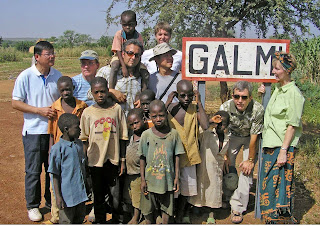
The Team. We began with our survey crew documenting the property boundaries and all existing site features while others hand-measured all the existing buildings. We investigated local building materials and construction practices. We met with administrators, doctors and reps from the national staff. We walked every inch of the property to understand its network of water and power systems and dug holes to test the soils: we were building the foundation for proposing a comprehensive redevelopment strategy.

But during the work week we also set aside time to pray together, study God’s Word, go to local church services, visit the market, play with children and pray with patients. Some of these precious moments brought smiles, some brought tears while others brought both. Each night the last lights were not turned off and our laptop screens did not go dim until the early morning hours.

The Results. Saturday morning was our Final Presentation to all missionary staff both administrative and medical. We explained how a redeveloped facility would have more natural light, catch prevailing winds for natural ventilation, repel the hot sun and have spacious corridors. We talked about how patients would have access to fresh air and a place to sit in shade outside their rooms. We assured them that even though the redevelopment would take several design and construction phases, eMi promised to return as often as needed and be the common thread to re-tune the master plan if needed and conduct detailed design for each subsequent new building. Our presentation was met with hope and optimism.
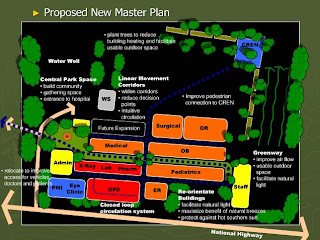
It will always be the doctors, the medical staff and the resident evangelists who will foster both temporary and lasting change in the lives of the patients. However, if our new facility creates a better work environment for the doctors, medical and support staff and enables a more comfortable experience for patients, than our efforts will be called a success.

Project Photos. A new set of photos has been uploaded to my Photo Gallery for this project, so click here (Photo Gallery) and see the Galmi Hospital set with a slideshow. If you want to read a description of each photo, you can also take a look at the photos in Details (Photo Details). Check it out and see what your support and encouragement has produced in the work of this team. "Thank you" to all our prayer and financial supporters for making projects such as this a reality.

Tuesday, September 04, 2007

Back to Africa in the Fall


Project 5445 - Galmi Hospital for SIM in Niger
Redevelopment of a 110 bed surgical hospital.
September 26 - October 9

Niger has been ranked the poorest nation in the world by the United Nations. This land-locked country in western Africa sits on the edge of the Sahara Desert and has few natural resources to its benefit. Average life expectancy at birth is 41 years. 12% of its newborn’s die before their first birthday. The doctor/population ratio is one doctor for every 30,000 citizens. In such a difficult environment, SIM has spent more then 50 years meeting compassionate medical care needs through the Galmi Hospital. With 110 beds for inpatient care this surgical hospital also cares for up to 300 men, women and children at their on-site outpatient clinic every day.

But the buildings and the supporting infrastructure (water, power, waste management) are literally crumbling. The whole hospital complex is in need of major repair and reconstruction. However, some major challenges exist in undertaking a reconstruction project on such a busy, fully functioning hospital. How can most of the facilities be kept operational while portions are undergoing redevelopment? How can a scattering of ancillary buildings be incorporated into a new facility in a logical, pragmatic manner? How can a reorganization of the overall site Master Plan be done to free up land for potential expansion of medical services? How is the existing infrastructure to be rebuilt and reorganized to become efficient at meeting current needs while being capable of accommodating potential increases in medical services, such as the addition of more outpatient and inpatient clinics?


The mandate of our eMi team of volunteer design professionals is to listen to the needs of the hospital and within our project week, to produce a vision and supporting documentation for the overall redevelopment and reconstruction of Galmi Hospital. We will present to them a phasing plan for a step by step redevelopment of the hospital and produce construction documents that will help them build it. With our team actually going to Niger we will be able to see, understand and incorporate local materials and construction methods. We will also be able to dialogue continuously with SIM administrators as well as the medical and support staff to receive direct input and feedback during our project week.

Please pray for sensitivity, open ears, open hearts and open minds as we put the best of our professional skills to the task of blessing this ministry and the innumerable patients this hospital will be witness to in displaying the love, care and concern first demonstrated by our Lord Jesus. He lived out His very commands to us, time and time again, to love the poor, heal the sick and feed the hungry. Our efforts will extend this compassion in a very real way to the people of Niger through the work of SIM and the staff of Galmi Hospital.


See the side bar for a link to the www.emiworld website for the project description. If you are curious what participating on an eMi team looks like, click on the video A Project Week With eMi. Thank you to each of you who are involved by supporting me, my family and the work of eMi with your financial and prayer support.

Monday, July 02, 2007

Central Asia – Designing a K-12 School


eMi Project In A Former Soviet Republic. When dates for this project were initially confirmed, I was disappointed that we would miss seeing the students by one week. What’s designing a school when you don’t get to meet the kids? However, I was later told it was good we missed a busy graduation week and besides, once we met the administrators and teachers, most of whom had kids in the school, and some of the missionary parents, it was not hard to see the powerful impact a new, expanded MK school will make in Central Asia.


Great hat!

Supporting Those Dedicated to Serve. Missionaries in Central Asia typically take on many roles. One role, of course, is to live out their faith and spread the Good News of Jesus. Another is to hold a job which allows them to live in the country. To this end, some missionaries are in business, some are involved in high tech industries, while others are in teaching, counselling etc. In all, some 34 different ministries were currently represented in the student population of 250. We met one woman who is the director of a Christian counselling center. Two of her national staff told us their heart wrenching but inspirational stories of life in a country where abuse is common, corruption is rampant, family structures are breaking down and the easiest “out” in such desperation is the cheap alcohol found at every corner store.

Of course many missionaries are parents of school aged children. In this region with dramatically low public education standards, unless MK parents are prepared or equipped to home-school, most rely heavily on the presence of a missionary kids (MK) school to ready their “third culture”* kids for life or school in their “home” country upon high school graduation. Charging fees about 1/5 of a comparable private international school the school we served provides an international level of education at a very reasonable cost. However, the need for educational spaces is exceeding available space and resources. It was this need, a simple note in my church bulletin last December that started a relationship between this school and eMi.

* “third culture" kid - a child who 1) did not grow up in their passport country 2) isn’t truly Central Asian (or wherever their parents happen to be serving) and 3) grows up in a unique “3rd culture”


Christian counselling center

Design A 5,200 m2 (56,000 sf) K-12 School For 300 Students…In Six Days! Most of our team landed at 4 am on Sunday the 17th. We had all met, most for the first time, just hours before at Heathrow Airport in London. Two architects, a civil engineer, an electrical engineer and an architectural draftsman. Our Aussie surveyor had landed 30 hours previous and had already begun his land survey. Immediately, while still in a daze, we began our education about the country, the history of the school and the piece of land on which a new building would be built.

It had been decided by a local Project Manager that it would be both difficult and costly to find local professionals who would master plan the new property and sit down to envision this school along with administrators and staff. However, he said that if a preliminary design could be done, it would be more manageable to find professionals to take over the design, to ensure adherence to local building codes, and to gain local permits and ultimately to construct the school. Our work included master planning the property, designing the school (expandable to 500 students), locating and sizing the water/waste water infrastructure, estimating power needs, and locating sports activity zones and areas for potential future development. Our objective was to provide a completed preliminary design with written reports over five days “in-country” and two weeks of post-trip work. During our work week in-country we walked the site, surveyed the property, interviewed numerous administrators and teachers and spent many hours working in a hot, muggy classroom in the old school.

The school was a rabbit warren of small rooms, convoluted hallways and stairways with no two steps the same in height or depth: a remnant of Soviet era construction. This building has already been deemed unsafe to meet the demands of a 10.0 earthquake that could rock this region at any moment…and historically has.


Our architect explains her design

After numerous design variations and explorations, on Friday and Saturday we presented our completed work to local professionals, school administrators, teachers and parents. There was consensus that our design suited their needs. By Gods amazing grace, even under the stress and pressure of time and the massive scope of the project, our team, mostly strangers a week before, had become a cohesive unit. Now at home, we have two weeks to complete more drawings and produce a written Final Report which will document our investigations, what we designed and why we designed it that way. The first shovel is anticipated to hit soil in August. Children’s voices are expected to be heard in the new hallways in September, 2008.

What a blessing to be part of such work with individuals who understand that submission to God’s call to use our skills in service, while praying for His grace and wisdom in the process, produces results that bless so many!

What’s A Report Without More Photos? A new set of photos has been uploaded to my Photo Gallery for this project, so click here (Photo Gallery) and see the Central Asia set with a slideshow. If you want to read a description of each photo, you can also take a look at the photos in Details (Photo Details). Check it out and see what your support and encouragement has produced in the work of this team.

Thank you for coming alongside me, my family and the work of eMi!

PS. All specific place and photo references have been obscured to ensure safety for all of our contacts in Central Asia.

Friday, June 01, 2007

Haiti…no…Central Asia…ah…Uganda…Central Asia!

I have now "officially" been the leader of three different teams this Spring. Through it all we prayed for God's guidance in all matters and now that all is resolved, we can clearly see His guidance in all things. The months of project approval, volunteer recruitment and preparations are finally coming to an end: it's now "go time" for the Spring project cycle. First however, much has happened the past six weeks since my last post, so let me fill you in.

SUMMIT MEETINGS IN CALGARY. During the first week of May, five senior staff members of eMi USA came up to Calgary for a series of meetings with our growing staff. From exciting envisioning meetings to dry (but necessary!) administration topics the week was intense but ultimately encouraging. Although legally separate entities, there is no denying the unity of vision and inherent DNA in the ministries conducted under the banner of Engineering Ministries International.

RETURNING STAFF AND FOUR NEW INTERNS. Also in May we welcomed the return of our part-time staffers, Patrick Cochrane and his wife Joan. This year Patrick wears the mantle of Intern Coordinator and has helped to formalize our intern program, using eMi USA as our model and sounding board. Rose (UBC - Engineering), Wes (Royal Military College - Engineering), Sarah (U. of Guelph - Engineering) and Evangeline (U. of Illinois – Architecture), are our four interns this summer. Rose and Wes are traveling with Kevin to Haiti while Sarah and Evangeline are traveling with Steve to Uganda. Our little office is filled to its limits, going from two to eight in just two months!

THREE PROJECTS ON THREE CONTINENTS. Three out of thirteen international projects being conducted under the banner of eMi this Spring cycle is being led out of the Canada office.

Haiti. Kevin, just seven weeks on staff is already conducting his first trip as Project Leader. He is currently co-leading a team with eMi Central America Director, Tom Bastian, to Haiti to design new orphanage facilities for God’s Littlest Angels (http://www.emiworld.org/projectprofile_5429.html). This wonderful orphanage is already home to 200 infants and toddlers and ultimately will have the capacity to be home to 300 infants and toddlers. Besides site planning and building design the team will be exploring wind power technology to reduce the cost of operations for this busy home.

Uganda. Steve, eMi Canada director, will be leading a team to Mukono, Uganda to design a medical clinic and a hospice care home for Reach One Touch One Ministries (ROTOM). ROTOM serves the needs of poor and homeless seniors, an often neglected and forgotten part of society (http://www.emiworld.org/projectprofile_5431.html) when it comes to aid and mercy ministries.

Central Asia. From June 15th to the 26th, I will be headed to Central Asia with a team to master plan and initiate design for a school that serves the educational needs of missionary kids. The parents of the 200 students are missionaries with 34 different missionary organizations. As their parents work to spread the Good News of Jesus to the people of this region, considered the least reached in the world, the students will be looking to this international school to receive an education at Western standards. Our master plan will enable expansion to 500 students and include both boarding facilities and staff housing (http://www.emiworld.org/projectprofile_5430.html).

UP NEXT. Shortly after the return of all teams, the entire staff and interns will be going down to Jackson Hole, Wyoming to help celebrate eMi’s 25th Anniversary. Not just four days of festivities, the weekend will include workshops, professional development courses, and training sessions for leaders and volunteers of the new Disaster Relief arm of eMi. (http://www.emiworld.org/conference2007.html)

Thank you for coming alongside us on this journey. We are always thankful for you.