Tuesday, June 03, 2008

Seminary Redevelopment in the DR Congo

Country. On June 18th my next eMi team will be traveling to the Democratic Republic of Congo. Our final destination will be Boma, a port city on the tiny western Atlantic coastline of the third largest country in Africa. This is a country that has been devastated with military strife, poverty and HIV/AIDS. Although it is blessed with an abundance of natural resources, the power struggle to control these vast resources has also been the root of much of the conflict.

From 1998 to 2003 the country suffered through the Second Congo War, often referred to as the African World War. Although treaties were signed in 2003, related fighting still persists in the eastern portions of the country. Our team is going to the western edges of the DRC, which has seen little of the recent unrest.

Ministry. FACTEB seminary school was founded close to 30 years ago and today is showing the ill effects of age, of war and a lack of resources for regular maintenance. But with the peace that has come to this region in recent years there are now new efforts underway to restore, and indeed increase, its capacity as a place for higher education and the training of pastors and biblical scholars. Dr. Mabiala Kenzo, a professor at Ambrose University College has recently moved back to his homeland to become the Rector for FACTEB and is our main contact for this project. Funds from sponsoring groups such as the Christian and Missionary Alliance of both Canada and the USA are ready to be released. However, funding groups have been reluctant to release resources while FACTEB is lacking a long-range strategic plan for the redevelopment and growth of its facilities.


Dr. Kenzo in a typical classroom


Goals. The plan of our eMi team is to come alongside the administrators of FACTEB seminary to produce such a set of documents. These will include written analyses of the existing facilities, recommendations for the renovation of existing buildings, design for high priority new buildings as well as construction budgets and phasing strategies. The team will also produce a new overall master plan for the campus. Phase One will be what the ministry can realistically build in 24-36 months. Beyond that, more eMi teams can be sent to design subsequent phases in detail and also revisit the master plan, as there are likely to be changes in scope and/or vision as the seminary grows.

Meeting Additional Needs. In a country torn by strife, poverty and disease, leadership that brings hope and a foundation for peace is greatly needed. The graduates of FACTEB seminary will strive to meet that need with spiritual leadership in the churches and in the community. Biblical teaching and pastoral training will always remain the primary focus of FACTEB. However, with a property that is close to 80 acres in size the seminary wants to also explore other avenues for meeting need in the local context, such as vocational training.

The eMi team will investigate the potential for incorporating vocational training on the campus property. Vocations that pertain to construction can be used to benefit the reconstruction of FACTEB and provide important jobs and training for the local population. Such facilities could also be a source of monetary funding that can be put back into the seminary.

Prayer Items. The team will be traveling by both road and domestic air transport. Please pray for travel safety for the team, unity as we endeavor to serve the seminary and both vision and wisdom in our work.

Thank you to all who continue to support my work and my family through your donations and prayer. I am thankful for each of you as I go to serve wonderful ministries such as FACTEB in the DRC.

Thursday, February 28, 2008

Centre For Peace and Reconciliation


“...under the thin surface of busy activity and new construction, the scars and pain of barely suppressed memories remain painful and raw…”  Pastor Eddie Mwunvaneza

The Circumstances.  Thirteen years after a one hundred day nightmare when almost one million people died, many at the hands of neighbours and people they considered friends, the majority of those who lived through that time remain emotionally traumatized and deeply wounded.  In fact, much of the hustle and bustle of Rwanda’s capital city Kigali is not being generated by those who endured the one hundred days of genocide: much of the activity is being generated by former refugees, returning home after many years away from their homeland to help rebuild their nation.  They have re-introduced a spirit of liveliness and optimism but for those who lived through the trauma, moving on is no simple task.

Unlike what many believe, the dividing line of the genocide was not tribal.  The fact is that the Rwandese is one people; the labels were merely traditional economic distinctions that were rather benign until they were exploited by colonizing powers as a means to divide and play favorites…to tragic results.

The Challenge.  Even church and community leaders have said openly to Pastor Eddie that they would like to be first in line for counseling for emotional healing.  During our team’s stay in the midst of the lively capital, where road paving and building construction can be seen everywhere, not one person who heard us say “we are hear to design the facilities for a peace and reconciliation ministry”, failed to comment that this will fill a great need in their nation.

The Ministry.  African Link Developments, spear-headed by Eddie and Bonita Mwunvaneza, has a vision for a place where professional counseling for individuals can take place, where families can come together for healing, where vocational training can occur for widows and where activities that involve and bring together a whole community can happen.

Pastor Eddie is himself a former Rwandese refugee.  Raised for a time in Uganda and mostly in Canada, Eddie is burdened with the task of “returning home” to be catalyst in the healing of his nation.  As one who follows Christ, Pastor Eddie knows that healing of the emotion is not enough if there is no healing of the soul.  His aim, therefore, is to bring into the healing process an opportunity to hear and know the Good News.  This is therefore a centre for peace and reconciliation not only of people to people and people with themselves but also a place for spiritual peace and reconciliation as well.

The Task.  The goal of the eMi team was to master plan the 2.3 acre hillside site and design all the required facilities and infrastructure.  Experientially the planning would take advantage of the beautiful sweeping views, the existing vegetation and the natural fall of the land for building placement and the location of pathways to both quiet places of contemplation and prayer as well as places of group activities and sports.  In terms of engineering the team needed to understand the structural as well as absorption capabilities of the soil.  Rwanda is rain forest nation with periodic deluge of very heavy rainfall.  Managing surface water run-off on a hill-side site will be critical; making it part of the architectural design would be a huge bonus.

The Work.  In a week that began with listening to Eddie share his vision, the eMi team then investigated local construction practices and building materials.  The team walked the site numerous times while the surveyor (David) and his helpers (daughter Ashli and intern Philip) began to document its boundaries, topography and features.  Architects Dan and Beth concentrated on site planning and building design while architect/builder Mike looked after material specifications and a construction cost analysis.  Structural Engineer Phil work closely with the architects to establish the structural systems of the buildings (in the end three types were used) while Civil Engineers Rod and Joyce analyzed the soil and the water and designed both the fresh water and waste water systems.  As for me I coordinated all events of the week as I did my best to find a balance between research, work, ministry, team devotional time and simple relaxation.  And yes, we found time to buy souvenirs for our families back home.

The Ministry. Besides the fundamental need to complete our task a huge part of eMi is ministry time.  This essentially means time spent with the local population, to care for needs and share our time and attention.  For us this was often as simple as playing with the neighbourhood kids at the property.  All of us visited an orphanage and a home for abandoned children with mental and physical challenges.  While there we gave away clothing, foodstuff and lots of stickers and even candy.  Most of all we gave our hands and arms to hold, even if it was just for a while during that day.

Some of us met with a group of young adults who were encouraged by our desire and willingness to travel halfway around the world to come alongside Pastor Eddie in his ministry.  A few of us spent time teaching widows how to make jewelry with simple found materials (hey, they were really beautiful!) so that they could earn some money.  We visited two genocide memorial sites and stayed a while to interact with the local children.  And in all this we tried to learn some local greetings, to make an effort to really be in the place and not merely passersby.  We got laughed at a lot for our efforts but it was always in good spirit as our efforts were appreciated.

The Results.  The team did a fantastic job all week.  It had been an emotionally challenging week but everybody found the strength to remain focused on our task.  In the end Pastor Eddie sat silently and absorbed our Final Presentation.  In the end we were pleased because he was pleased.  At eMi was often say: “in the end, it’s not about a building.”  Although very true, our primary task as a group of professionals is to deliver the right design.  I am proud of the work of the team as they designed a counseling/guest house center, a vocational training centre, a beautiful multipurpose building with traditional Rwandese influences and a staff-housing block.  Also on the site are several gazebos in quiet locations, a grassed play area for kids, a basketball/group activities court, car parking that is out of view and a delightful surface drainage system that integrates with the site circulation with little bridges.

My Experience.  This was an emotionally and even spiritually difficult and at times very painful trip.  By mid-week after visiting the genocide memorial sites I found myself despairing and almost wishing to leave.  But Pastor Eddie kept telling us: “The story is not finished.  You are here to continue the story with healing, reconciliation and hope.”  His constant reminder re-invigorated me and our team and we were able to complete our task with praise and thanksgiving.

Project Photos.  A new set of photos has been uploaded to my Photo Gallery for this project, so click here (Photo Gallery) and see the Kigali, Rwanda set with a slideshow (click the middle of the photo for commentary).  If you want to spend a little more time looking and reading click here in Details (Photo Details).  Check it out and see what your support and encouragement has produced in the work of this team. “Thank you” to all our prayer and financial supporters for making this project a reality.

Tuesday, January 15, 2008

Rwanda Centre For Peace and Reconciliation

History. Rwanda has long been considered one of the most scenic, lush and beautiful countries on the continent of Africa. However, in April of 1994, an unspeakable horror broke out in this small, land-locked nation. In a rampage of genocide that split down tribal lines 800,000 people were killed in just 100 days. This was no invading army or faceless pilots dropping bombs from the sky. These were roaming bands of Rwanda’s own citizens and the killings were often brutal scenes of neighbours killing neighbours, most dying within arms length of their machete bearing executioners.


ALD Missionary Eddie Mwunvaneza (r)

Consequences. Beyond the many who were killed, a few hundred thousand Rwandans fled their homes and were displaced. But many on both sides of the conflict returned. When killers and those whom they sought to kill suddenly become neighbours once more, how can they possibly live again in such close proximity? How does one heal from the physical as well as the deep emotional, psychological and spiritual wounds? With a justice system capable of bringing neither true peace nor reconciliation, healing itself becomes slow and painful.

Healing. After 14 years, Rwanda has made measured strides to keep moving forward even as it heals from within. But the personal, inner challenges of its citizens continue and a number of Christian ministries have been born from these these times to help people seek true peace and reconciliation. African Link Developments (www.africanlinkdevelopments.com) is one such group.

Ministry. In applying for an eMi team to help them design their Centre for Peace and Reconciliation, African Link Developments (ALD) stated as its Purpose:

“To strengthen the church in the war torn country of Rwanda, still wounded by the aftermath of the 1994 genocide. The ministry will train pastors and provide trauma counseling resources. We hope to bring healing to the nation through providing counseling, reconciliation and tolerance training for often desperate people, especially widows and orphans, who can also be supported through skills training.”


A Piece of Land with Many Possibilities

For true healing to take place, God must be present, experienced, and known. The one who's name is Healer must be in the centre, in the midst, of true and genuine healing. Then there is a need for the practical, pragmatic tools with which to live and so there will be counselling, education and vocational training. ALD has raised enough funds to purchase a 3 acre parcel of land and now the next step is to build a facility, a place of ministry. Our eMi Canada team will produce a site master plan for their raw piece of land and design the buildings for a training/counseling centre, residences for orphans (with widows as guardians) and a school for the children.

More Info. See the side bar for a link to the project description on the www.emiworld.org website. If you are curious what participating on an eMi team looks like, click on the video “A Project Week with eMi”. Thank you to each of you who are involved by supporting me, my family and the work of eMi with your financial and prayer support.

Sunday, October 21, 2007

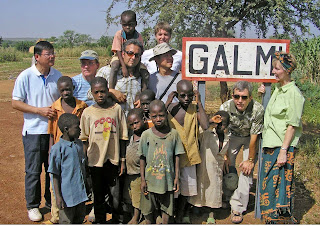
Redevelopment of Galmi Hospital in Niger

The Doctors. The missionary doctors and medical staff of SIM’s Galmi Hospital in Niger do some amazing work. After almost 50 years of striving to provide the best health care possible, Galmi Hospital is considered the top medical and surgical hospital in this country of 10 million people. They do all this despite working in a facility where the main hospital building is almost 50 year old. Even the best conceived and best built 50 year old hospitals in North America are considered tired and outdated. In the harsh conditions bordering the Sahara Desert with its sandstorms and daily temperatures hovering in the mid-40’s Celsius, no building stands a chance. Add in narrow corridors, dim lighting, stale air and resulting smells that assault the senses and the great work done here becomes all the more remarkable.

The Hospital. Niger is one of the poorest nations on earth and we saw it first hand. I would reflect later that it was one of the most emotionally difficult trips I have ever been a part of. The poverty was staggering and the needs beyond comprehension. However, even as we observed the challenging conditions, including the over-whelming number of out-patients (up to 300 per day) and witnessed the crushing need and palpable despair, something else was slowly being revealed. After arriving on Saturday evening we had first met the missionary doctors, administrators and their families on Sunday during a potluck lunch but on Monday we saw many of them in action in and around the hospital. Rather than being repulsed, as we initially were, the doctors moved easily in and among the people. Holding hands, touching arms, speaking softly: we saw love in action that moved us deeply. For the remainder of the week as we worked to create redevelopment plans for the hospital and interacted with the local population we faced a similar challenge: living out God’s love with grace and sensitivity while dealing with our task at hand with professionalism, efficiency and integrity.

The Team. We began with our survey crew documenting the property boundaries and all existing site features while others hand-measured all the existing buildings. We investigated local building materials and construction practices. We met with administrators, doctors and reps from the national staff. We walked every inch of the property to understand its network of water and power systems and dug holes to test the soils: we were building the foundation for proposing a comprehensive redevelopment strategy.

But during the work week we also set aside time to pray together, study God’s Word, go to local church services, visit the market, play with children and pray with patients. Some of these precious moments brought smiles, some brought tears while others brought both. Each night the last lights were not turned off and our laptop screens did not go dim until the early morning hours.

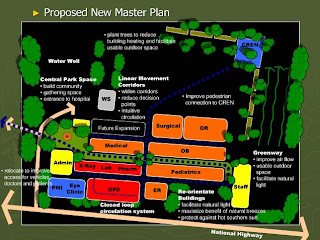
The Results. Saturday morning was our Final Presentation to all missionary staff both administrative and medical. We explained how a redeveloped facility would have more natural light, catch prevailing winds for natural ventilation, repel the hot sun and have spacious corridors. We talked about how patients would have access to fresh air and a place to sit in shade outside their rooms. We assured them that even though the redevelopment would take several design and construction phases, eMi promised to return as often as needed and be the common thread to re-tune the master plan if needed and conduct detailed design for each subsequent new building. Our presentation was met with hope and optimism.

It will always be the doctors, the medical staff and the resident evangelists who will foster both temporary and lasting change in the lives of the patients. However, if our new facility creates a better work environment for the doctors, medical and support staff and enables a more comfortable experience for patients, than our efforts will be called a success.

Project Photos. A new set of photos has been uploaded to my Photo Gallery for this project, so click here (Photo Gallery) and see the Galmi Hospital set with a slideshow. If you want to read a description of each photo, you can also take a look at the photos in Details (Photo Details). Check it out and see what your support and encouragement has produced in the work of this team. "Thank you" to all our prayer and financial supporters for making projects such as this a reality.