Friday, March 14, 2014

A School to Give Children a Chance

Foothills 294
STEP.  The Society for Transformation, Education and Progress (STEP) was established by second-generation Indian Christians in Odisha state, a part of India that is very hostile to the Gospel.  In fact, in 1999 a Christian missionary, Graham Staines, who had spent many years establishing schools and community development projects was burnt alive along with his two sons in their car.  But from that tragedy the Indians whose lives were positively touched by their efforts established STEP to carry on the work of the Staines to love the people of this region.
Foothills 302
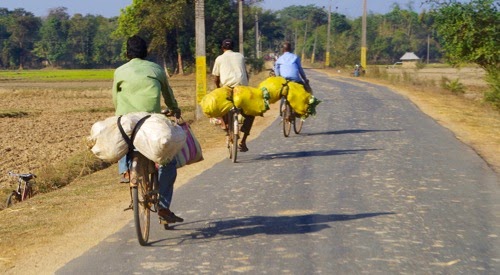
The Location.  In early February our team of seven, with team members who call Canada, USA, Scotland and India (Delhi) home, arrived by SUV into the rural village of Hatigarh, five hours north of Bhubaneswar, the state capital of Odisha.  In this village off the beaten track from the main highway, most houses are built with traditional mud brick, mud plastered walls and grass roofs. Our task was to design a K-7 school, some children’s residences for those who live too far to walk to school and housing for staff and teachers.
Foothills 297
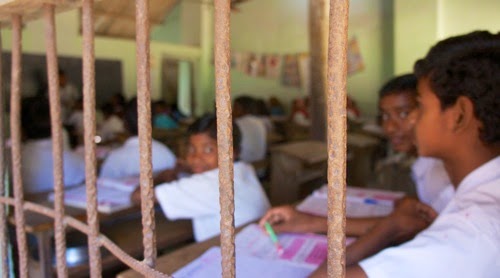
The School.  The goal of STEP in building this school is to provide over 500 rural children from families of all castes and religions a chance to receive a good education and have hope for the future.  Children in this very disadvantaged area of Odisha in eastern India attend public schools where it is common to find 100 students in each class.  So one vision is to build a school with affordable tuition (even public schools charge fees for books and uniforms) where classes will be 35 students per teacher.
Foothills 301
Sewing Class.  STEP also recognizes that vocational training and employment opportunities are very hard to find in a place where most families rely on subsistence farming on small plots of land.  So STEP started a sewing school for women.  Our team was able to not only attend the graduation of the first sewing class but we were invited to the opening of a tailor shop so the women would have employment.  I was given the immense privilege of cutting the ribbon!
Foothills 300
Love of Jesus.  At the root of all their efforts STEP is motivated by love; their love for God and for the people of India.  While the school and all vocational training opportunities are open to all faiths and castes, it is no secret that living out the love of Jesus is a foundational motivation for the work of STEP.  And the people are not complaining.  Certainly not the ladies in the first graduation class who gladly told us with joy how their new skills and employment would greatly help their family and how much they looked forward to having a school of quality for their children.
Foothills 303
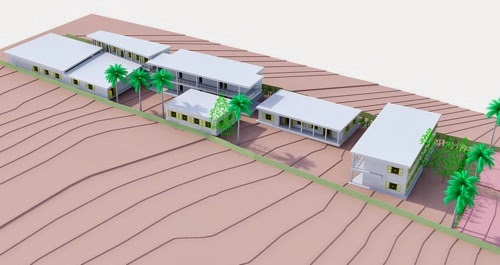
Our Work.  On the long, narrow STEP property (until they acquire more land for Phase 2) we developed a school with a multi-purpose auditorium and a library, both of which will not only serve the school but the community as well.  India requires all school children to receive one meal each day at school so there is a cafeteria and of course, open space for the children to play.
Foothills 299
Further into the property will be residences for teachers and staff adjacent to medical clinic.  At the rear of the property will be STEP’s guesthouse and boarding residences for children who live to far to walk to school each day.
PrimarySW
Project Photos.  A new project video has been added to the right-side menu and a new set of annotated photos has been placed in my Photo Gallery with various options to view it.  If you want to browse the set, click here.  If you want to see the titles and read the captions of each photo, click here.
StuSEV
Thank you to all who make this work possible through your encouragement, prayer and financial support; you have been a part of making this project, and the resulting touched lives, a reality.

Tuesday, January 07, 2014

Children's School and Home in India

The Ministry.  STEP exists to impact people (Society) with the gospel (Transformation), knowledge (Education) and hope for social mobility (Progress).

The Need.  Government schools are located in larger centres and in poorer states, even when they exist they often provide very poor quality of education.  The poor are unable to afford school fees or the transportation costs when they live in remote villages.  Compounding the issue is if a family is from a lower caste as they are highly discriminated against.

Cropped cropped INDIA NEPAL 2008 C 399
The Solution.  STEP seeks to break down class and economic barriers to education and opportunity.  Their goal is to positively touch the lives of destitute children and their families regardless of their income or social standing…and regardless is the child is a boy or a girl.  In fact, their website explicitly states that special consideration will be given to girls and those from persecuted groups due to their vulnerability.  Children who attend this school from families with more finances will subsidize children from poor families through school scholarships.

eMi Involvement.  Our team of engineers and architects will be designing a K-7 school as well as a residence for 100 children who’s families live too far away and who do not have daily transportation options.  No status (high or low caste) will be maintained and children of any caste will learn and live together.

To read more about this eMi project click here.  To visit the STEP website click here.

Please keep us in prayer as we travel in the air and on the ground and also remember all team member families as we are away for this project.  Thank you to all our supporters and friends who make it possible for me to do this work.

Thursday, June 20, 2013

The Hope of a New Home

The Place.  Haiti has come a long way since January 2011 when a massive earthquake rocked this small Caribbean nation.  Slowly but surely the slabs of broken concrete have been chipped to rubble, mostly by hand, and carted away and reconstruction began soon after in the midst of sprawling tent cities.  Street clearing programs established to remove mountains of rubble have transitioned into street cleaning programs, with a noticeable positive effect on the look and feel in many parts of the city.
Driving through Port au Prince


Resilience and Faith.  The people of Haiti are resilient.  Surviving 200 years of bitter living conditions first under colonialism and even through independence, from one corrupt leader to another, it often seems little is left but to be resilient.  But there is more going on then is first easily seen.  From its voodoo past, Haiti is slowly transforming into a hopeful country.  Many decades of Christian missions, embodied in often small scale neighbourhood level efforts, provides a marked counter-point to the despair and discontent one might expect to find.
DSCN1946
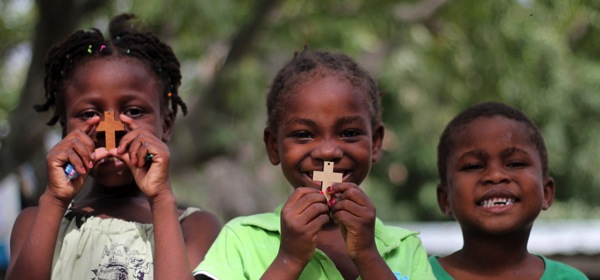
Children from Life is Hope 'B' greeting us in song
Hope.  It is true: many (if not most) missions have the word "hope" in their names.  So many, in fact, that one can hardly be faulted for getting their names mixed up.  But hope is in there for a reason, because Christian missions, when done well in a culturally sensitive, patient, "long perspective" way brings hope not just for education, jobs and material betterment but hope to the soul as well.
DSC0047  Version 2
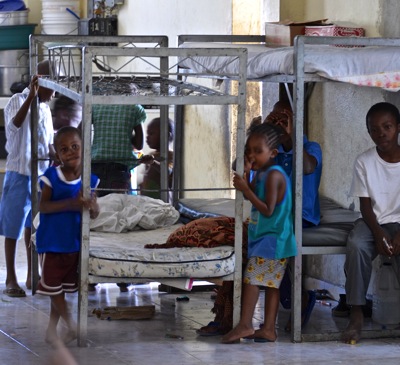
The current conditions in the rented home are more crowded than ideal
Life is Hope Orphanage.  This orphanage was started by Haitian pastor Jean Larochel as a response to orphaned children, not necessarily of parents who have passed away but of parents unable to feed, house and care for them.  Through no fault of their own these children face the potential of abandonment but often worse; becoming indentured servants to other, slightly better off households willing to buy their services.  These children (often referred to as "restaveks", Creole for the French "reste avec" or "to stay with") seldom get schooling, are often abused and receive the worst morsels of food in often already poor households.  These children grow up with little hope for a productive future…but Pastor Jean wants to change that.
DSCF2175
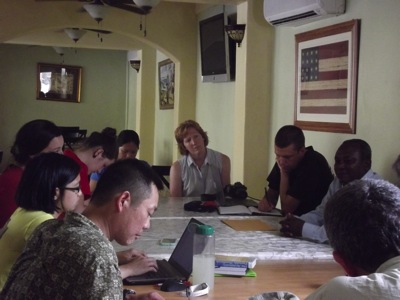
Our first meeting listening and learning about the Life if Hope vision from Pastor Jean Larochel
A Place to Call Home.  Life is Hope Orphanage was established before the earthquake and quickly grew in numbers after the earthquake.  Almost 170 children now live in two rented facilities but these are not suited or large enough for the children.  Renting is also an unstable situation, with tenants suffering at the whim of landlords.  So Praying Pelican Missions has come alongside to help by purchasing a parcel of land and inviting eMi to master plan their property.
Haiti 133
Rod, our civil engineer conducting the survey chats with a boy from the neighbourhood
Re-uniting Families.  But while we were tasked to design an orphanage, a loving and caring home for such children, the intent is not for these children to be adopted away from Haiti.  In fact, a major goal is to reunite them with their birth families.  But the only way to achieve this is if the parents can be able to afford to take them back.  So the orphanage is step one, the next step in Pastor Jean's vision include providing vocational training for adults, many of them the parents of these children.  Another part of the vision is to establish a school and community centre, where children receive a good education and families come to build community.
IMG 2445
Our team at work and in discussions with Pastor Jean during our week of work
Baby Steps First.  But the first step is to build the orphanage and an adjacent guesthouse.  This guesthouse will provide visiting teams (such as eMi!) a place to stay but also become a funding source for the orphanage and a place where skill and job training can happen.
Site 4
SketchUp model of the proposed orphanage (foreground) and guesthouse
Project Photos.  A new project video has been added to the right-side menu and a new set of annotated photos has been placed in my Photo Gallery with various options to view it.  If you want to browse the set, click here.  If you want to see the titles and read the captions of each photo, click here.
4 ISO  1stFLR
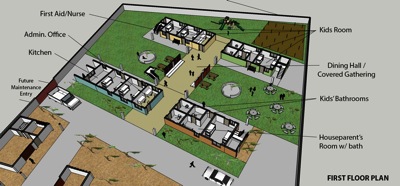
Cut-away of the ground level of the orphanage
Thank you to all who have made this work possible through your financial support, encouragement and prayer; you have been a part of making this project, and the resulting touched lives, a reality.

Friday, May 24, 2013

Life is Hope Orphanage - Haiti

The Ministry.  In the days following the January 2010 earthquake, few orphanages in Haiti escaped a swell in the number of children they cared for.  Such was the case for Life is Hope Orphanage in the neighbourhood of Croix des Bouquets on the eastern edge of Port au Prince, the capital city.  With 100 children living where there was formerly 60 and with the realization that few families were able or even alive to claim the children, the orphanage began to make plans to better care for the children.

A Partner.  As a ministry operating under a family of Haitian Baptist churches, Life is Hope Orphanage received hope for its future when church leaders invited an American missions organization called Praying Pelican to become involved.  Praying Pelican is an organization that arranges short term mission opportunities for American churches and so began a relationship where mission teams began to visit Life is Hope Orphanage to help meet some of their needs.

Featuredpic
The Need.  It didn't take long to realize that the current facilities of the orphanage had become inadequate to house and feed the children and have adequate facilities to provide schooling for all the children.  The leader of Life is Hope Orphanage, Pastor Jean Larochel, began to search for land to purchase and found it on the northeast edge of Port au Prince.  These underdeveloped land was spacious but had no services and utilities; it became clear that a construction project with little in-house understanding of planning and construction would be a great challenge to overcome.

eMi Canada Comes Aboard.  eMi Canada first received an email inquiry from a Board member of Life is Hope in November 2012.  After further emails, phone calls and a completed eMi Canada Project Application, the project was approved to receive an eMi team.      I will be jumping in to help with the architectural design, leading a team with two interns (U of Manitoba, Ball State) and volunteers that will include an architect (North Carolina), an electrical engineer (Saskatchewan), a structural engineer (California), two civil engineers (Illinois and New York) along with two spouses who will join us to help the team and spend time at the orphanage.

IMG 5252
The Project.  eMi Canada will be there to develop a master plan, design all the facilities needed house, feed and care for the children.  Also, there will be enough land for school buildings and a guesthouse for visiting teams.  As donations are raised to purchase more land, Life is Hope has a vision to build adjacent vocational training facilities so as the children grow up, they can be taught practical skills of a trade.

To read more about the project on the eMi Canada website click here: Project 10038 - Life is Hope Orphanage

Please keep us in prayer as we travel in the air one the ground and also remember all team member families as we are away for this project.  Thank you to all our supporters and friends who are making it possible for me to do this work.  I will update this blog as I am able in Haiti but for sure will provide a follow-up upon our return.